
A Sound Strategy Still Fails Without an Aligned Senior Team


A sound strategy does not create alignment. It creates the need for it.
Senior teams spend significant time defining priorities, debating investments, setting goals, and deciding where the organization needs to go.
A strategy gets approved. Typically everyone around the table appears to agree. Then the meeting ends. One executive protects their function. Another interprets the priority differently. A difficult trade-off between competing priorities gets postponed. Two leaders give their teams conflicting direction. A decision everyone thought was settled appears on next month's agenda. Sound familiar?
The strategy may be sound. The senior team may simply not be aligned enough to execute it. And this is likely more than an organizational-design preference. Research involving more than 125,000 employees across approximately 1,000 organizations identified two factors as particularly important to effective strategy execution: clear decision rights and strong information flows.
In other words, deciding where the organization is going is only part of the work. Leaders also need clarity about who makes which decisions, how competing priorities are resolved, and whether the information needed to make those decisions moves effectively across the organization.
A good strategy creates opportunity. Alignment follows when senior leaders make trade-offs, clarify decision rights, resolve competing priorities, and keep commitments across the enterprise.

Imagine a senior leadership team agrees that improving the customer experience is one of its three most important priorities. Everyone supports it. Then the work begins.
Operations believes reliability should come first. Sales wants greater flexibility for key customers. Finance is concerned about margin. Technology argues that legacy systems must be addressed before meaningful improvements can occur.
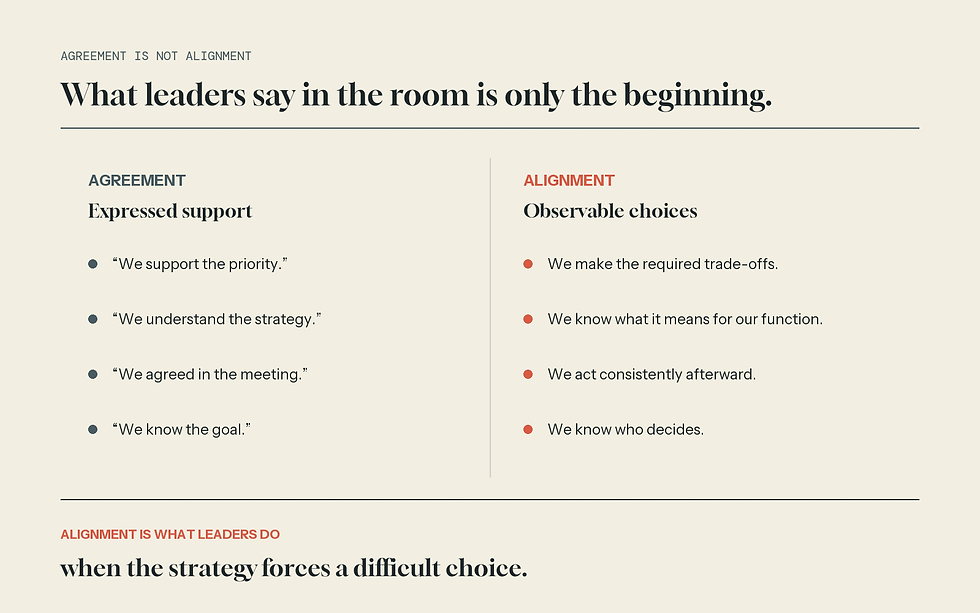
None of these perspectives is necessarily wrong. The problem emerges when the team has not worked through the trade-offs between them. Everyone can agree with the strategy while making perfectly reasonable decisions that pull the organization in different directions. Agreement is not alignment.
Alignment becomes visible when leaders make difficult decisions consistently with the priorities they agreed to pursue.
Strategy Becomes Real in the Trade-Offs
Most strategies sound good at a high level.
Grow the business. Improve customer experience. Increase operational excellence. Develop our people. Innovate. The real test comes when two good things compete.
What happens when growth conflicts with margin? When responding to an important customer creates operational complexity? When hitting this quarter's target competes with investing in future capability?
Strategy is not simply deciding what matters. Strategy becomes real when leaders decide what matters more.
If the senior team has not worked through those choices, the organization is forced to resolve them lower in the hierarchy. Different functions make different decisions. Employees receive competing direction. Issues get escalated. Priorities appear to change depending on which executive is speaking.
What looks like an execution problem may actually be an unresolved leadership-team problem.
The Organization Experiences the Senior Team
Employees rarely experience strategy through a strategic plan. They experience it through decisions.
Which deadline moves?
Which project gets funded?
Who has authority to make the call?
Which metric matters when two metrics conflict?
What happens when one executive's priority collides with another's?
Every one of those decisions teaches employees what the organization's strategy actually is.
When different executives provide different answers, employees eventually stop trying to interpret the strategy and start interpreting the executives.
Decisions slow. Cross-functional friction increases. Leaders protect resources. Meetings revisit questions everyone thought had been settled. People learn to optimize for their function rather than the enterprise.
The organizational chart may show one leadership team. The organization may experience several.
Alignment Doesn't Mean Agreement
An aligned senior team is not a team without disagreement. Operations should see things differently than sales. Finance should raise considerations other functions may miss. Technology may recognize constraints others underestimate.
Those perspectives improve decisions when you surface them and work through them.
The risk is not disagreement. The risk is unresolved disagreement disguised as alignment.
Healthy senior teams challenge assumptions and debate trade-offs before deciding. Then they make the decision clear and understand what it requires from each function.
That requires enough candor to disagree before the decision—and enough enterprise commitment to support it afterward. Otherwise, disagreement simply moves somewhere else: hallway conversations, delayed execution, competing messages, passive resistance, or next month's agenda.
Sometimes Misalignment Is a Decision-System Problem
Not every alignment problem is relational. Sometimes the senior team agrees on the strategy but has never designed how decisions will be made when priorities collide.
Consider a decision involving sales, operations, finance, and technology.
Who has input? Who decides? What criteria govern the choice? What happens when two enterprise priorities conflict? Without those answers, organizations tend to default to hierarchy, politics, or local discretion.
Some decisions escalate unnecessarily, turning the CEO into a bottleneck. Others get made independently inside functions, creating consequences elsewhere. Still others repeatedly return to the senior team's agenda.
The problem may not be commitment to the strategy. The team may be missing the decision architecture required to execute it.
Alignment requires clarity about who has input, who decides, what criteria guide important choices, how trade-offs will be resolved, and what everyone commits to after the decision.
Senior-team alignment is not something you declare at the end of a strategy meeting. You design it into the decisions, trade-offs, commitments, and accountability that follow.
Work on the Real Work
When senior teams struggle with alignment, the instinct is sometimes to schedule a retreat or team-building exercise.
Those experiences can help. But if the problem lives inside actual priorities, decisions, trade-offs, and accountability, that is where the alignment work needs to happen.
Take one important strategic priority and put it in the middle of the table. Ask:
What does success actually look like?
What are the difficult trade-offs?
Who has input, and who decides?
Where do functional priorities compete with enterprise priorities?
What decisions keep resurfacing?
Where are we saying yes in the room but behaving differently afterward?
This turns alignment from an abstract discussion about teamwork into observable leadership behavior. It also helps diagnose the actual constraint.
Some barriers are structural: unclear priorities, conflicting measures, ambiguous decision rights, or diffuse accountability. Others sit beneath the surface: avoiding conflict, protecting turf, struggling to support a decision you opposed, or a CEO who wants distributed decision-making but steps back in whenever the stakes rise.
Changing the meeting agenda will not solve a trust problem. Building trust will not clarify who owns a decision. Diagnose the constraint before prescribing the solution.

Is Your Senior Team Actually Aligned?
Instead of asking whether everyone understands the strategy, choose one of your most important strategic priorities and ask whether the team can execute it together.
When functional and enterprise priorities conflict, which wins?
Once it is set, do they communicate and act consistently?
Can executives challenge one another before a decision?
Can every executive explain the priority the same way?
Do the same issues keep returning to the agenda?
Have you discussed the difficult trade-offs?
Are decision rights clear?
These questions reveal more than asking whether everyone supports the strategic plan.
Alignment isn't what leaders say when the strategy is presented. Alignment is what they do when the strategy forces a difficult choice.
From Strategy to Performance
A sound strategy can still lose value inside the Risk Zone, the period between a consequential leadership decision and the organizational performance that decision is intended to create.
Strategic & Leadership-Team Risk appears when the strategy may be sound, but the senior team is not aligned enough to make and execute the trade-offs required to deliver it.
The answer is not necessarily another strategy session. Sometimes the team needs greater clarity. Sometimes decision rights need to change. Sometimes unresolved conflict needs to surface. Sometimes accountability needs to become explicit. And sometimes leaders themselves need to change how they behave when priorities collide.
The question is not simply: Do we have the right strategy? Ask instead: Is our senior team aligned enough to make the decisions, trade-offs, and commitments required to execute it?
Because strategy does not execute itself. The organization experiences the strategy through the behavior of the senior team.
If your senior team repeatedly revisits decisions, gives competing direction, or struggles to resolve enterprise trade-offs, the issue may not be commitment to the strategy. It may be the operating conditions required to execute it.
Organizational Talent Consulting’s Executive Advisory work helps senior leaders identify and address the specific constraint through a blend of coaching and consulting, whether decision rights, trade-offs, accountability, conflict, or leadership behavior is the constraint.
Learn more about Executive Advisory and download the white paper: Executive Advisory: Where Coaching and Consulting Come Together


References
Doolittle, J. (2023). Life-Changing Leadership Habits: 10 Proven Principles That Will Elevate People, Profit, and Purpose. Organizational Talent Consulting.
Doolittle, J. (2026). Executive Advisory: Where Coaching and Consulting Come Together. Organizational Talent Consulting.
Edmondson, A. C. (1999). Psychological safety and learning behavior in work teams. Administrative Science Quarterly, 44(2), 350–383.
Lu, L., Yuan, Y. C., & McLeod, P. L. (2012). Twenty-five years of hidden profiles in group decision making: A meta-analysis. Personality and Social Psychology Review, 16(1), 54–75.
Neilson, G. L., Martin, K. L., & Powers, E. (2008). The secrets to successful strategy execution. Harvard Business Review, 86(6), 60–70, 138.
Rousseau, D. M. (2020). Making evidence-based organizational decisions in an uncertain world. Organizational Dynamics.


